Dental clinics manage aerosols, odors, and airborne particles throughout the working day. During ultrasonic scaling, tooth preparation, and polishing, fine particles may remain suspended near the dental chair. An effective air sterilizer can support ventilation and surface-cleaning routines. It cannot replace them.
The real question is not simply, “Which model has the highest airflow?” It is “How to select an air sterilizer for dental clinics” based on room size, patient flow, noise, maintenance, and verified performance. A practical review should examine clean air delivery rate, filtration stages, filter replacement access, and operating costs. HEPA filtration may capture very small particles, while activated carbon can help reduce certain odors. UV-C systems require careful engineering and shielding. Marketing language alone is not enough.
Look at the treatment room.
Measure its volume. Note the ceiling height, chair position, waiting areas, and existing ventilation. A loud unit may be ignored or switched off during treatment. A weak unit may run continuously without achieving useful air changes. Check independent test data, manufacturer instructions, and certification claims before purchase. Ask how staff will monitor filters and clean external surfaces. Small details matter, such as a sealed filter compartment and a clear maintenance indicator.
No sterilizer is perfect. Dust loading, open doors, and poor placement can reduce real-world results. I have seen well-designed equipment perform poorly when placed behind cabinets or beside a wall. That is a useful reminder: selection should consider daily behavior, not only laboratory specifications. A reliable choice supports infection-control procedures, protects staff comfort, and fits the clinic’s actual workflow.
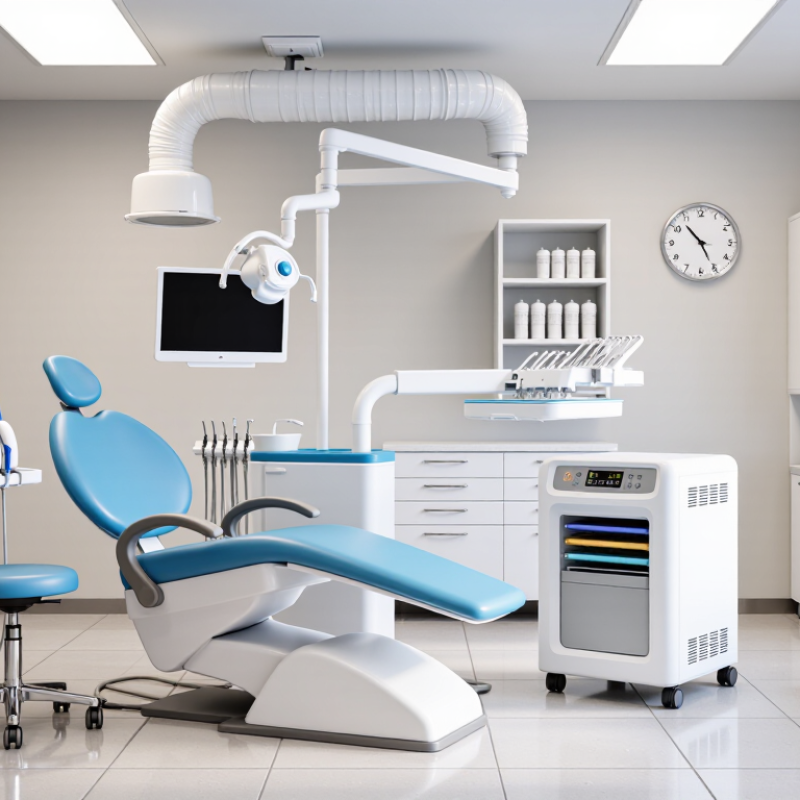
Air sterilization in a dental clinic means reducing airborne contamination around patients, staff, and treatment areas. HEPA filtration is a central control, but it is not identical to sterilization. A properly rated HEPA filter captures 99.97% of particles measuring 0.3 micrometers under defined test conditions. This particle size is difficult to capture, so larger and smaller particles are often trapped efficiently too. Still, capture is not killing.
In a busy operatory, check the cleaner’s airflow, room coverage, noise, and filter condition. A powerful filter with weak airflow may protect less than expected. Look for tested HEPA performance, sealed housing, and clear replacement guidance. Air changes per hour also matter, especially near dental chairs where aerosols can linger. Avoid relying on a single portable unit.
Maintenance requires discipline. Inspect seals, record filter changes, and monitor airflow with a simple pressure reading. Do not place the intake behind cabinets or curtains. UV-C may support air treatment, but its effect depends on exposure time, dose, and safe enclosure. It should not replace HEPA filtration or source control. A practical weakness remains: published capture percentages may not reflect a crowded room, open doors, or neglected filters. Choose equipment based on verified performance and daily clinical conditions, not impressive claims alone.
Choosing an air sterilizer for a dental clinic starts with room ventilation, not the device box. CDC targets commonly use 6 air changes per hour (ACH) for existing treatment rooms and 12 ACH for new construction or major renovation. Confirm current guidance and local requirements before making a purchase.
Measure the room, airflow, and actual air changes with a qualified professional. A small treatment room may need different equipment from a large surgical area. Place the air-cleaning unit where it does not disrupt the dental chair, staff movement, or fresh-air supply. Check noise levels too. A loud machine may be switched off during treatment, which defeats its purpose.
Air sterilizers can support ventilation, but they cannot replace it. Select equipment with documented airflow, filtration performance, maintenance needs, and safe operating controls. Filters should be easy to inspect and replace. Ultraviolet systems require careful shielding and professional installation. In practice, clean filters often receive more attention than blocked vents. That is a mistake. A spotless filter does not prove effective room circulation. Recheck ACH after layout changes, new partitions, or equipment installation. My own preference is to record readings, service dates, and staff observations, while accepting that one measurement may not describe every busy clinical hour.
Match room ventilation to CDC-referenced air-change targets: 6 ACH for existing spaces and 12 ACH for new or renovated spaces.
Use 6 air changes per hour as the reference target when evaluating an existing dental treatment room.
Design for 12 air changes per hour where a new ventilation system or major renovation is being planned.
An air sterilizer or purifier supplements ventilation; it does not replace outdoor-air exchange or proper filtration.
Reference values shown: 6 ACH for existing spaces and 12 ACH for new or renovated spaces. Confirm final requirements with local codes, facility engineers, and current infection-control guidance.
Choosing an air sterilizer for a dental clinic requires more than comparing advertised airflow rates. Each technology controls airborne risks differently. HEPA filtration physically captures fine particles, including many aerosols produced during drilling or ultrasonic scaling. It does not remove gases, and its performance depends on airflow, filter fit, and regular replacement. In a busy operatory, a poorly sealed filter can undermine an otherwise strong system.
UV-C at 254 nm works by damaging microbial DNA and RNA. However, the air must receive enough radiation for long enough. Dust buildup, weak lamps, shadows, and fast airflow may reduce effectiveness. I once considered UV-C a simple “kill switch.” That view was too optimistic. Choose equipment with measured dose data, protected lamp placement, and maintenance records. Staff should never face exposed UV-C radiation.
Bipolar ionization charges airborne particles, encouraging them to combine or settle on surfaces. Its results vary with room size, humidity, airflow, and electrode condition. Some systems may produce unwanted by-products, so independent emissions testing matters. Ask for clear laboratory evidence, not only marketing claims. In practice, I would compare tested clean-air delivery, noise beside the dental chair, filter access, and service intervals. A monitor showing particle changes during a real procedure can reveal weaknesses that brochures miss. No device replaces ventilation, surface cleaning, or sensible chairside source control.
| Evaluation Dimension | HEPA Filtration | UV-C at 254 nm | Bipolar Ionization |
|---|---|---|---|
| Primary operating principle | Mechanical removal of airborne particles as air passes through a dense fiber filter. | Ultraviolet-C radiation damages microbial DNA or RNA, preventing replication when the delivered dose is sufficient. | Electrically generated positive and negative ions interact with airborne particles and microorganisms; performance depends strongly on device design and operating conditions. |
| Typical particle-removal capability | A certified H13 filter is rated at least 99.95% efficient and H14 at least 99.995% at the most penetrating particle size under EN 1822 testing. | Does not physically remove particles. Microbial inactivation varies with irradiance, exposure time, airflow, humidity, lamp condition, and shielding. | May reduce particle concentration by agglomeration or increased deposition, but results are not represented by a universal filtration-efficiency rating. |
| Microbial-control evidence | Captures bacteria, fungi, and many virus-containing aerosols; capture is not the same as inactivation, so filter handling and replacement require care. | Can inactivate susceptible microorganisms, but a complete system requires a documented UV dose and adequate air mixing or exposure time. | Published performance is variable and highly application-specific; it should not be described as sterilization without independent, device-specific validation. |
| Best role in a dental clinic | Primary removal of airborne dust, droplets, and aerosol particles in treatment rooms, waiting areas, and laboratories. | Supplementary air disinfection in a properly engineered recirculating unit or upper-room system, with shielding and safety controls. | Potential supplementary particle-management technology only after independent testing and indoor-air-quality review. |
| Important performance metric | Clean Air Delivery Rate (CADR), airflow, filter class, pressure drop, and room air changes per hour. | UV dose, irradiance, exposure time, lamp output over its service life, airflow, and validated microbial reduction. | Verified clean-air delivery, particle reduction, by-product testing, ozone concentration, and performance at the intended airflow. |
| Effect on aerosols | Directly removes aerosols from the air stream when the unit is correctly sized and operated. | Leaves particles in the air unless combined with filtration; inactivated particles may still require removal. | May cause particles to aggregate or deposit on surfaces, which can increase the importance of cleaning and surface hygiene. |
| Ozone and by-product concern | Normally no ozone is generated by the filter itself; check the complete unit for other components that may emit ozone. | 254 nm lamps can generate ozone if they emit shorter wavelengths, so use ozone-free lamps or verify measured emissions. | Some ionization devices can generate ozone or other reactive by-products; require independent testing against applicable indoor-air limits. |
| Maintenance requirements | Replace filters according to pressure-drop, operating-hour, or manufacturer criteria; use appropriate precautions when handling used filters. | Clean lamps and reflectors, verify lamp output, replace lamps at the specified service interval, and prevent direct exposure to people and eyes. | Inspect electrodes or modules, clean dust deposits, verify output, and periodically test ozone and other by-products. |
| Noise and energy considerations | Fan noise and energy use increase with airflow and filter pressure drop; high-efficiency filters generally require adequate fan capacity. | Lamp power is relatively predictable, but fans still determine much of the total energy use in air-handling systems. | Electrical energy use may be low compared with fan power, but total energy and noise depend on the associated air-moving system. |
| Main limitations | Does not disinfect surfaces, does not remove gases, and becomes less effective if airflow bypasses the filter or the filter is overloaded. | Requires sufficient dose; shaded areas, high airflow, dirty lamps, and inadequate mixing can substantially reduce effectiveness. | Performance can vary widely; ionization is not a substitute for source control, ventilation, filtration, or validated disinfection. |
| Selection priority | Choose a unit with independently verified CADR, suitable airflow, low leakage, an accessible filter, and a documented filter class. | Choose only systems with documented UV dose, safety interlocks or shielding, lamp-life data, and ozone-emission verification. | Choose only systems with independent validation under the intended operating conditions and transparent by-product test results. |
| Overall suitability for routine dental aerosol control | High when correctly sized, maintained, and combined with adequate ventilation and source controls. | Useful as a supplementary control when dose and safety are demonstrated; not a stand-alone guarantee of sterilization. | Use cautiously as a supplementary option; evidence and by-product safety must be verified for the specific device. |
Clean-air performance should begin with a room calculation, not a product label. Measure the treatment room’s length, width, and average ceiling height. Multiply these figures to find room volume in cubic meters. Then use ACH = CADR ÷ Room Volume. CADR means clean air delivery rate, usually measured in cubic meters per hour.
For example, a 60 m³ operatory with a 600 m³/h CADR provides 10 air changes per hour.
Measure twice. Small errors matter.
A dental clinic needs more than a high ACH number. Check whether the stated CADR applies to the selected operating speed, not only the highest setting. Confirm the filtration or disinfection method through credible laboratory data.
Airflow should move across the occupied zone without blowing directly over instruments or patients. In practice, poor placement can reduce real performance, even when the calculation looks impressive. Noise also matters because patients may already feel anxious.
Consider doors opening, staff movement, treatment duration, and nearby rooms. These factors can reduce effective air exchange. A unit with adjustable speed may support quieter care during examinations and stronger cleaning between appointments.
Maintenance is equally important: loaded filters restrict airflow and can lower CADR. Keep service records and replace components according to verified instructions.
The formula is useful, but it is not perfect. Actual performance still deserves measurement and honest review.
Top Air Sterilizers for Dental Clinics: How to Choose?
Choosing an air sterilizer for a dental clinic requires more than checking airflow claims. Start with evidence. CDC guidance supports ventilation, filtration, and infection-control practices, but it does not automatically approve specific devices. Request independent test reports, installation records, and maintenance instructions before purchasing. The unit should match the treatment room’s size, occupancy, and operating schedule.
ASHRAE 62.1 focuses on acceptable indoor air quality and outdoor-air ventilation. It does not certify an air sterilizer. Confirm that the equipment will not reduce required airflow or create uncomfortable drafts near patients. Measure supply and return airflow after installation. Document filter changes, pressure readings, and service dates. Small oversights matter.
ISO 14644-1 classifies airborne particle cleanliness in controlled environments. It does not prove that a dental room is microbiologically sterile. This distinction is often missed. Particle counts can support room assessment, but they cannot replace CDC-based infection-control procedures. Ask whether testing used calibrated instruments and clearly defined sampling locations. A report without these details may look professional but remain difficult to verify. Consider noise, ozone risk, access for cleaning, and safe operation around staff and patients. Perfect compliance is rarely achieved on the first attempt. Recheck performance after renovation, equipment relocation, or ventilation changes.
Existing treatment rooms commonly target 6 air changes per hour. New construction may target 12 ACH. Confirm current local guidance.
Measure room length, width, and average ceiling height. Multiply them for room volume in cubic meters. Use ACH = CADR ÷ room volume.
A 60 m³ room with 600 m³/h CADR provides 10 air changes per hour. Measure twice. Small errors matter.
No. It can support ventilation, but cannot replace fresh-air exchange. Blocked vents remain a serious problem.
Keep it away from dental chairs, walking paths, and fresh-air supplies. Air should cross the occupied zone without blowing directly over patients.
Confirm documented airflow and filtration performance. Check the operating speed behind the stated CADR. Highest-speed results may not reflect daily use.
Noise matters. A loud unit may be switched off during treatment. Adjustable speed can support quieter examinations and stronger cleaning between appointments.
Inspect filters regularly and replace them according to verified instructions. Loaded filters restrict airflow and reduce CADR. Keep service dates and readings.
Yes. Recheck ACH after adding partitions, moving equipment, or changing the room layout. One measurement may not represent every busy clinical hour.
The formula is useful, but it is not perfect. Doors, staff movement, and treatment time can reduce real air exchange. Honest review helps.
Choosing the right dental air sterilizer begins with understanding how each technology improves indoor air quality. HEPA filtration can capture 99.97% of particles at 0.3 micrometers, while UV-C light at 254 nm helps deactivate microorganisms as air passes through a properly designed chamber. Bipolar ionization may offer additional particle-control support, but its safety performance and emissions should be carefully evaluated. The best option depends on room size, occupancy, airflow patterns, maintenance needs, and the level of infection-control support required.
How to select an air sterilizer for dental clinics also requires matching the system to ventilation targets. Existing spaces should generally aim for 6 air changes per hour (ACH), while new designs may target 12 ACH. Required clean-air delivery can be estimated using ACH = CADR ÷ room volume, allowing the system capacity to be compared with the room’s dimensions. Finally, verify that the design, installation, filtration, and monitoring approach aligns with CDC guidance, ASHRAE 62.1, and ISO 14644-1 principles.

Estetik Medical