Hospitals face a stubborn mix of bacteria, viruses, and other microbes on frequently touched surfaces. UV-C offers an additional way to reduce this contamination when used in a carefully designed cleaning program. Its short-wavelength ultraviolet energy can damage microbial genetic material, disrupting the ability of many organisms to reproduce. Why is UV-C light effective against hospital pathogens? The answer is its capacity to act without applying a liquid disinfectant to every exposed surface. Yet effectiveness depends on the organism, equipment, and delivered dose. It is not a universal switch.
In practice, a UV-C unit may illuminate a vacant patient room after routine cleaning. Its lamps cast hard-edged shadows beneath bed frames and behind equipment. Those shaded areas may receive too little energy, so staff must position devices thoughtfully and follow validated operating instructions. Distance, exposure time, lamp condition, and room layout all matter. People must not remain in areas where equipment could expose them to harmful UV-C. Safety controls are essential. So is measurement.
Reliable infection-control guidance treats UV-C as a supplement, not a replacement for cleaning, hand hygiene, or appropriate disinfection. Hospitals should assess systems against relevant standards and monitor performance rather than trust a glowing display alone. Evidence also varies by setting, and real rooms are messier than laboratory tests. That limitation deserves attention. This article explains how UV-C works, what shapes its performance in 2026, and where careful use can support—not overstate—hospital infection prevention.
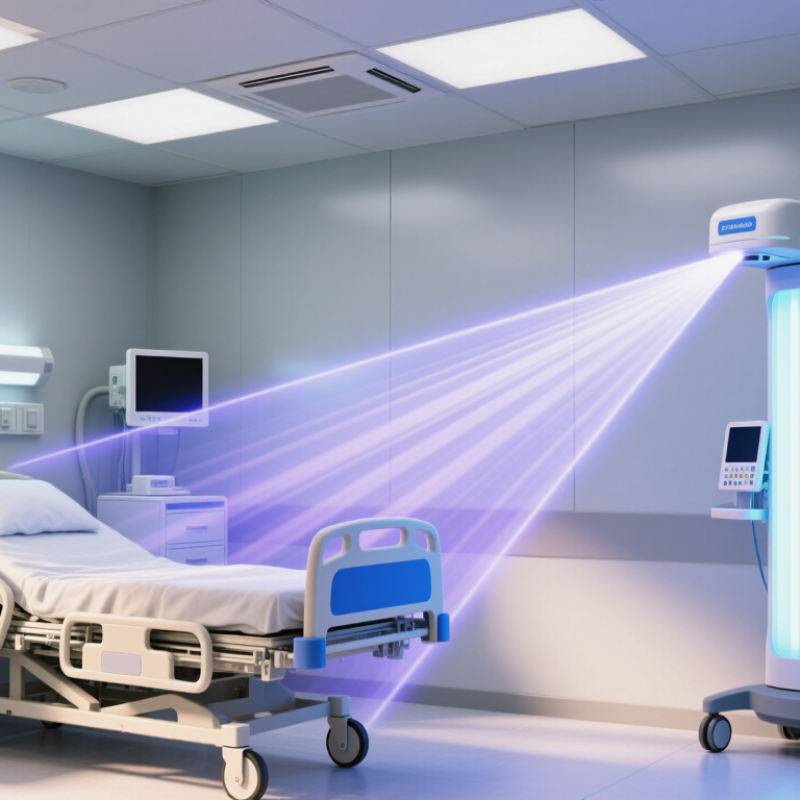
UV-C is ultraviolet light in the 200–280 nanometre range. Hospital disinfection units commonly use germicidal wavelengths to damage microbial DNA or RNA, stopping exposed organisms from reproducing. They are used as an extra step after manual cleaning, often during terminal room disinfection between patients. UV-C does not replace wiping away soil or disinfecting high-touch surfaces. It leaves no residue.
Evidence is promising but specific. In the 2017 BETR-D trial, published in The Lancet, adding UV-C to standard room disinfection was associated with a 30% lower risk of acquiring target pathogens among patients entering selected rooms. The trial involved more than 21,000 patients. That figure describes the study’s targeted organisms and settings, not a guaranteed reduction in every hospital infection.
Placement matters. UV-C works best when light reaches the surface directly; bed rails, equipment, and open doors can create shadows. Staff typically run mobile units in unoccupied rooms and follow the device’s exposure and safety procedures. CDC guidance treats UV technologies as supplemental environmental disinfection, not a substitute for routine cleaning. Shadows matter. Real rooms are cluttered, and that can make consistent coverage harder than a device’s test results suggest.
UV-C kills pathogens by disrupting the instructions they need to reproduce. At germicidal wavelengths, often around 254 nanometers, its photons are absorbed by DNA or RNA. In DNA, this can create pyrimidine dimers: lesions that block copying and gene expression. Some microbes may repair certain damage, so exposure does not guarantee instant inactivation. It depends on dose, organism, and conditions.
A dose is shaped by intensity and exposure time. Distance matters. So do dust, dried soil, and shadows beneath bed rails, where light cannot directly reach. The CDC’s Guideline for Disinfection and Sterilization describes ultraviolet devices as supplemental tools, not replacements for cleaning. In the 2017 BETR Disinfection trial across nine hospitals, Anderson and colleagues reported a 30% reduction in the composite risk of acquiring targeted pathogens when UV-C was added to standard terminal cleaning. That result supports careful use, not a promise of universal protection. A visibly clean surface can still hide a shadowed patch. That is easy to miss.
UV-C systems deliver germicidal exposure by directing short-wavelength ultraviolet energy onto surfaces after routine room cleaning. The radiation can damage microbial genetic material, limiting organisms’ ability to reproduce. Dose depends on both intensity and time. A lamp’s glow alone proves little. Actual exposure varies with distance, angle, lamp output, and room layout.
In practice, staff position mobile units or use installed fixtures according to a room-specific protocol. Beds, tables, and frequently touched surfaces need clear exposure paths. A bed rail facing the lamp may receive more energy than its underside. Shadows matter. Some systems record cycle conditions, but those records should be considered alongside maintenance checks and validated procedures. Records help. They do not replace validation. A worn lamp or dusty cover can reduce output, even when a cycle appears normal.
Because UV-C can harm eyes and skin, room-disinfection units are generally operated in unoccupied spaces with access controls and safety interlocks. Staff verify the room is clear and wait for the cycle to finish before re-entry. UV-C complements, rather than replaces, manual cleaning and infection-control practices. No cycle is perfect. Real rooms are messy; equipment shifts, and objects block light. That limitation deserves attention.
Illustrative UV-C dose at a fixed surface irradiance of 100 μW/cm²
UV-C can damage microbial genetic material and prevent replication. Dose depends on irradiance multiplied by exposure time: at the example irradiance shown, 30 seconds delivers 3 mJ/cm². The dose needed for a given level of inactivation varies by pathogen and conditions; distance, surface orientation, and shadowing can reduce the UV-C that reaches a target.
UV-C light can inactivate many hospital pathogens by damaging their genetic material. But a device does not disinfect every surface equally. Its effect depends on delivered dose, which combines light intensity and exposure time. A bed rail near a lamp may receive more UV-C than the underside of a bedside table. Distance, lamp angle, shadows, and room layout all matter. Small gaps matter.
Dust, dried body fluids, and other organic material can shield microbes from UV-C. Routine cleaning remains essential; UV-C is a supplementary step, not a substitute. Equipment condition and lamp output also affect performance, so facilities should follow manufacturer instructions and verify that treatment cycles reach intended areas. A room can look bright and still have poorly exposed surfaces. That is easy to overlook.
Tips: Remove movable obstacles and position equipment to reduce shadows. Use validated cycle settings, and track maintenance and treatment records. Keep people out of the treatment area unless the system is specifically designed for occupied use. Reflect on real room layouts: a protocol that works in an empty test room may need adjustment around carts, curtains, or equipment.
Hospitals treat UV-C as a controlled add-on, not a substitute for routine cleaning. At germicidal wavelengths, it can damage the genetic material of microorganisms when they receive an adequate dose. But dose changes with distance, exposure time, and shadows. A bed rail facing away from a lamp may receive less light than an exposed tabletop.
Before a cycle, staff remove people and pets, follow room-entry procedures, and confirm that cleaning is complete. The room must be empty. Warning signs, door controls, and motion sensors help prevent accidental exposure. Staff also inspect equipment and follow training for setup and cycle selection. Never assume a closed door alone makes a room safe. Procedures vary, and rushed handoffs can leave gaps.
Verification takes more than checking that a cycle ended. During commissioning and routine checks, trained staff can measure UV-C output with suitable, calibrated instruments at specified locations. Readings help identify weak lamps, poor positioning, or blocked light paths. Where appropriate, hospitals may also use biological indicators or other validated checks. Records should note equipment status, test locations, and corrective actions. A room can look ready while a shaded surface received too little exposure; that limitation deserves attention, not a confident guess.
| Topic | Hospital Practice | How Results Are Verified | Safety and Limitations |
|---|---|---|---|
| How UV-C inactivates pathogens | Germicidal UV-C damages microbial genetic material, preventing susceptible microorganisms from replicating. Performance depends on the UV-C dose that reaches the organism. | Facilities assess equipment output and delivered exposure using manufacturer procedures, calibrated UV-C meters, or validated dose-indicator methods. | UV-C is a disinfection method, not a substitute for routine cleaning or appropriate manual surface disinfection. |
| Common room-disinfection systems | Hospitals may use mobile, room-based UV-C devices after a patient has left and routine cleaning is complete. Many conventional systems use low-pressure mercury lamps near 254 nm; other lamp technologies are also available. | Staff follow the device’s validated operating instructions and document the room, cycle, device, and any cycle interruptions. | Effectiveness varies by device, room layout, surface location, exposure time, and the amount of UV-C reaching each surface. |
| Shadowing and line of sight | Staff position devices to expose key surfaces and may use more than one placement when the room layout creates blocked areas. | During commissioning or periodic checks, facilities can measure exposure at representative locations, including areas that are distant or partly obscured. | UV-C travels primarily along a direct path. Objects, equipment, bedding, and room geometry can shield microorganisms from exposure. |
| Exposure time and delivered dose | Cycle duration is set according to the device, target area, placement, and validated protocol; there is no single cycle time suitable for every room or pathogen. | Electronic cycle logs, device status indicators, and scheduled output checks help confirm that the prescribed cycle completed. Dose checks can support validation. | A completed cycle does not prove that every surface received the same dose or that every microorganism was inactivated. |
| Cleaning before UV-C | Staff remove visible soil and perform the facility’s required manual cleaning and disinfection before running a supplemental UV-C cycle. | Environmental-services checklists and established cleaning audits document completion of the manual cleaning step. | Soil and organic material can shield microorganisms. UV-C should not be relied on to clean visibly dirty surfaces. |
| Protecting staff and patients | For conventional room-based UV-C systems, the room is cleared during operation. Trained staff use controlled access, warning signs, remote operation, and door or motion safeguards as specified by the device. | Facilities review training records, access controls, safety procedures, and incident reports; they also check safety features according to the manufacturer’s instructions. | Direct exposure to germicidal UV-C can injure eyes and skin. People must not enter an operating area unless the system is specifically designed and authorized for occupied use. |
| Special case: far-UVC | Some systems use far-UVC wavelengths, such as around 222 nm, and may be designed for different operating conditions than conventional 254 nm equipment. | Evaluation should use the specific device’s regulatory status, validated performance data, operating limits, and applicable exposure guidance. | Safety depends on wavelength, exposure, device design, and applicable standards. “Far-UVC” should not be assumed safe for every occupied setting. |
| Routine performance management | Hospitals maintain written procedures for device placement, room preparation, operator training, maintenance, and reporting failed or interrupted cycles. | Periodic maintenance records, output checks, cycle logs, and risk-based environmental assessments help identify performance problems. | UV-C results should be interpreted alongside cleaning compliance and infection-prevention data, not as a stand-alone measure of infection risk. |
Key point: UV-C can provide supplemental environmental disinfection, but delivered dose, line of sight, proper cleaning, validated procedures, and exposure controls determine how it should be used and evaluated.
UV-C is ultraviolet light with wavelengths from 200 to 280 nanometres. Germicidal exposure can damage microbial DNA or RNA. Direct exposure matters.
No. Staff must remove visible soil and disinfect high-touch surfaces first. UV-C is an extra step and leaves no residue.
Often after manual cleaning, during terminal room disinfection between patients. Rooms remain unoccupied during cycles. The room must be empty.
It works best when light reaches surfaces directly. Bed rails, equipment, and open doors can create shadows. A shaded rail may receive less exposure than an exposed tabletop. Shadows still matter.
In selected rooms, adding UV-C was associated with a 30% lower risk of acquiring target pathogens. The trial included over 21,000 patients. Not a guarantee.
Staff clear people and pets, follow entry procedures, and use warning signs, door controls, and motion sensors. A closed door alone is not enough. Procedures can vary, and rushed handoffs may leave gaps.
Trained staff can measure output with calibrated instruments at specified locations. They may also use biological indicators or other validated checks. A completed cycle does not prove every surface received enough light.
Records can include equipment status, test locations, and corrective actions. Weak lamps or blocked light paths need attention. A room can look ready, but appearance is not proof.
UV-C light is a short-wavelength form of ultraviolet radiation used in hospitals to reduce microbes on room surfaces and in some air-treatment systems. Why is UV-C light effective against hospital pathogens? Its energy can damage the genetic material of bacteria, viruses, and other microorganisms, preventing them from reproducing. Hospitals typically use enclosed devices or mobile units that expose spaces to a measured UV-C dose after routine cleaning.
Disinfection depends on exposure time, lamp output, distance, and whether surfaces have a direct path to the light. Shadows, dirt, and complex equipment can limit the dose, so UV-C works best as a supplement to—not a replacement for—manual cleaning. Because direct exposure can harm people, rooms are cleared during operation and safety controls are used. Hospitals can assess performance through equipment checks, exposure measurements, and appropriate environmental testing.

Estetik Medical